

Weight and metabolism
Assess weight trajectory, adiposity and its consequences before choosing care goals.
The interface is available in English. Medical content currently remains in French; English medical editions will be added after scientific review.
© 2026 MICA — Médecine Interne Campus Algérie
Soraya Ayoub & Salim Larbani. Tous droits réservés.
LEARN AND EXPLORE
Choose an area to find its topics and related resources.
4 topics and related resources
Explore2 topics and related resources
Explore1 topic and related resources
Explore3 topics and related resources
Explore1 topic and related resources
Explore
Connect body composition, cardiometabolic risk and organ involvement. Find topics and investigations in one pathway.
LEARNING PATHWAYS
11 topics · 76 new sections · 11 teaching diagrams
Assess weight trajectory, adiposity and its consequences before choosing care goals.
Clarify cardiovascular risk, lipid abnormalities and liver fibrosis risk.
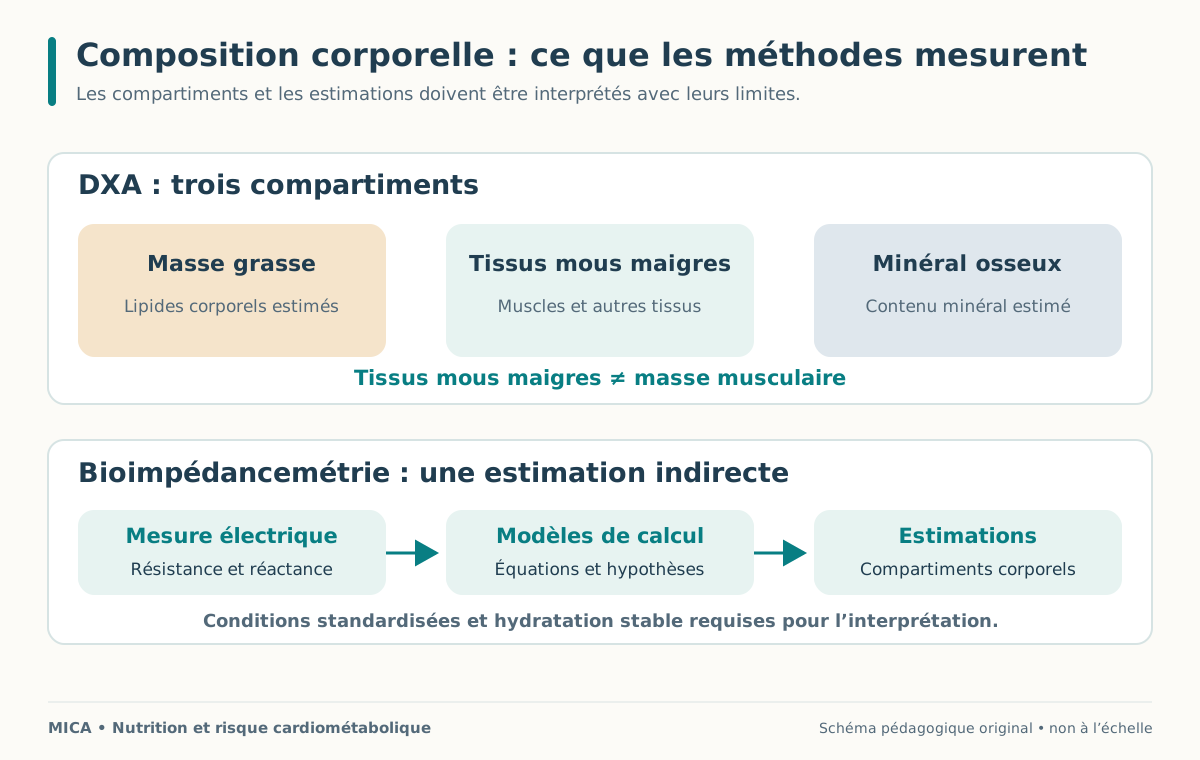
Distinguish weight, muscle mass, strength and intake. Obesity may coexist with malnutrition.
Each course offers expandable chapters, practical tables, an illustrated explanation and references.
MICA · CLINICAL LEARNING
Obesity assessment goes beyond weight to consider adiposity, medical complications, function and mental health. Care aims for lasting benefits agreed with the person within a respectful therapeutic relationship.
Record weight trajectory, relevant measurements, medicines promoting weight gain and previous treatment attempts. Body mass index alone does not describe fat distribution, muscle mass or clinical consequences. Assess functional limitation, sleep apnoea, joint impact and psychological difficulties. Obtain agreement before discussing weight and avoid inferring habits or motivation from appearance.
[1][2]Assess hypertension, dysglycaemia, dyslipidaemia, cardiovascular risk and liver disease according to clinical findings. Insulin resistance, Metabolic syndrome and MASLD develop these connections without making diagnoses interchangeable. In frail or older people, assess strength, intake and functional loss; obesity and malnutrition can coexist. Investigations should lead to useful action rather than untargeted testing.
[1][2]Combine individual nutritional care, appropriate activity, behavioural support and comorbidity management. Depending on indication, preferences and access, discuss medication or bariatric care with the competent team. Foreign recommendations do not constitute local product authorisation. Check indications and restrictions before prescribing; every approach requires coherent nutritional and clinical follow-up.
[1][2][3]Assess benefits in symptoms, quality of life, mobility and complications alongside weight change and tolerability. Weight loss with weakness, insufficient intake or digestive difficulty requires reassessment rather than automatic praise. Plan maintenance, relapse management and adjustment of other medicines. Explain that chronic disease requires continuing care without attributing every weight regain to personal failure.
[1][2][3]FICTIONAL SITUATION · WITHOUT A SCORE
Fictional situation: someone loses weight during treatment but reports eating very little and increasing difficulty climbing stairs.
Is weight loss alone enough to establish success?
No. Assess intake, tolerability, hydration, strength and other causes of weakness. Review the plan with the prescriber and nutrition team before escalation. Goals include function and metabolic health; weight loss accompanied by functional decline can indicate incomplete benefit or a complication.
Original educational synthesis for adult internal medicine. Individual care depends on the clinical setting, applicable product information and local pathways. These notes are not an institutional protocol or a certification. Independent human scientific review remains to be confirmed.