1846 · Public demonstration
16 October 1846: an anaesthesia demonstration in Boston
A public event at Massachusetts General Hospital becomes a landmark in surgical history.
Source & licence
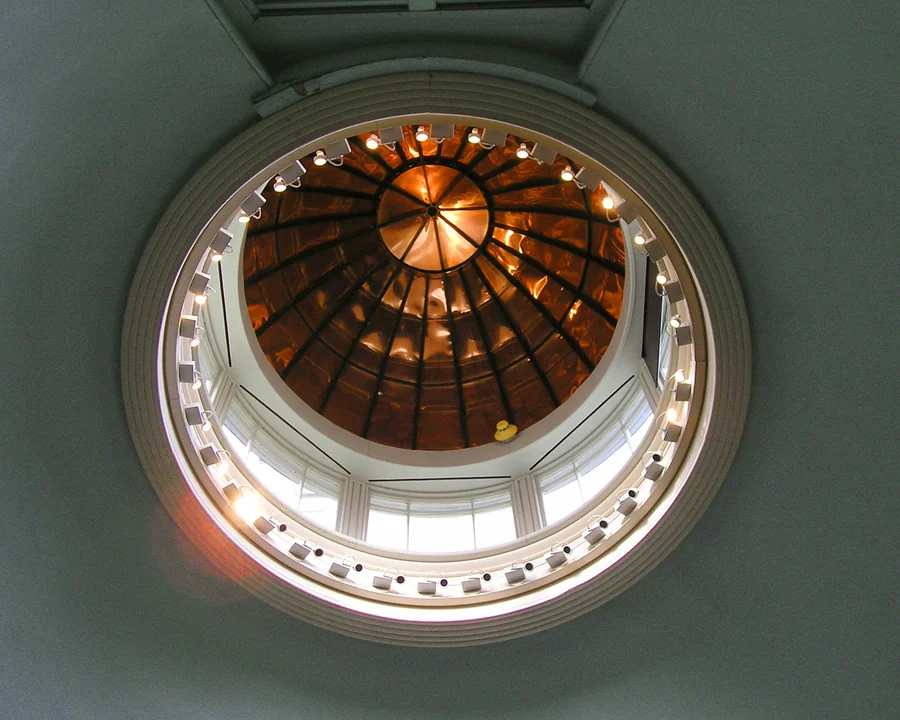
Adam Lenhardt / Wikimedia Commons / CC BY-SA 3.0
Source photograph · CC BY-SA 3.0
Full frame retained; proportional resizing and WebP conversion. Display fitted to the card frame. No generative retouching. Original licence retained.
Rights checked : 2026-10-10 · demonstration-ether-boston
Context
By the mid-nineteenth century, attempts to reduce surgical pain already had a history. Massachusetts General Hospital’s museum account recalls Horace Wells’s experiments with nitrous oxide and Crawford Long’s ether operations before 1846. These antecedents prevent the Boston event from being represented as an invention without preparation or the entire history of anaesthesia being assigned to one person.
What happened
On 16 October 1846, William T.G. Morton administered ether at Massachusetts General Hospital. John Collins Warren operated on Gilbert Abbott, who had a neck mass. The demonstration took place in the surgical amphitheatre now known as the Ether Dome. The museum reports that the patient described a scraping sensation without operative pain. The event recorded here is a successful public demonstration at an identifiable place and date.
People and institutions
Morton was a dentist and Warren a surgeon. Henry Jacob Bigelow helped arrange the encounter and communicate the result. Abbott should not disappear behind the professionals’ names: the event also concerned a patient’s experience. These roles were complementary but distinct. Arranging a demonstration, administering a substance, operating and disseminating an observation are not interchangeable actions.
Why it matters
A public demonstration makes an observation available for discussion by other practitioners. This episode allows us to examine how an innovation gains attention beyond the location of an experiment. A successful session, scientific recognition, priority disputes and the gradual development of practice remain different matters. The museum’s institutional account also preserves competing claims by Wells, Jackson and Morton.
Consequences
The room changed uses over time, and its preservation contributes to the transmission of this history. An old image may likewise construct a memory rather than directly witness the day. Robert C. Hinckley’s proposed painting was made decades after 1846. It must be described as a retrospective representation, never as a photograph of the operation. The date of the artwork and the date of the historical event remain separate.
What it means today
For MICA students, this episode encourages reading an institutional account alongside participants’ roles and an image’s provenance. The entry describes no anaesthetic protocol suitable for present-day practice. Its purpose is historical: to understand a demonstration, its dissemination and the limitations of a single-inventor narrative.
Key points
- 16 October 1846: a public demonstration at Massachusetts General Hospital.
- Morton, Warren, Bigelow and Abbott played different roles.
- Earlier experiments preceded the Boston event.
- Hinckley’s painting is a retrospective representation.
References
- About The Ether Dome
Paul S. Russell Museum of Medical History and Innovation, Massachusetts General Hospital · Consulted 2026-10-11
- The Ether Dome — Bulfinch by floor
Paul S. Russell Museum of Medical History and Innovation, Massachusetts General Hospital · Consulted 2026-10-11
- The first patient to whom Crawford Williamson Long administered sulphuric ether — MS C 86
National Library of Medicine, History of Medicine Division · Consulted 2026-10-11
- Henry Jacob Bigelow — Insensibility during surgical operations produced by inhalation
Wellcome Collection / Yale Medical Library / Medical Heritage Library · Consulted 2026-10-11
Documentary review in French and English. Historical facts are distinct from current clinical advice.