1927 · Birth
César Milstein: making antibodies reproducible
César Milstein was born on 8 October 1927 in Bahía Blanca, Argentina. With Georges Köhler, he developed hybridoma technology in 1975, before sharing the 1984 medicine Nobel with Köhler and Niels Kaj Jerne.
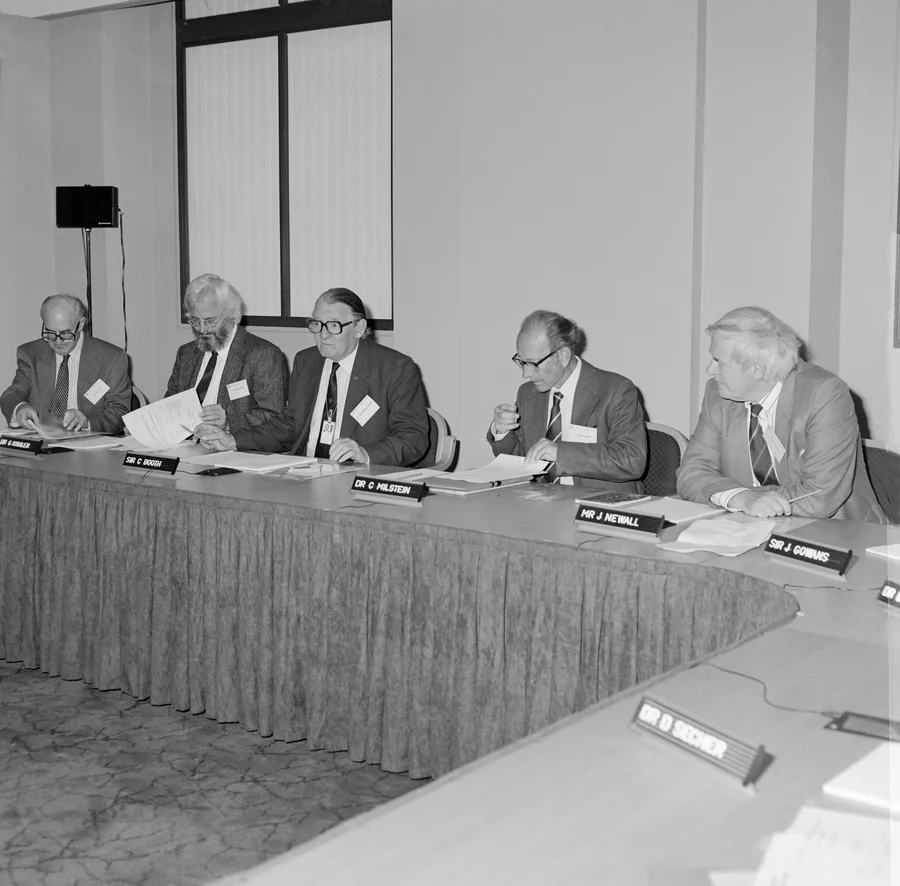
Source & licence
History of Modern Biomedicine Research Group / Wellcome Library / Wikimedia Commons
Source photograph · CC BY-SA 4.0
Full frame retained; proportional resizing and WebP conversion. Display fitted to the card frame. No generative retouching. Original licence retained.
Rights checked : 2026-10-10 · naissance-cesar-milstein
Context
Immunology had to explain antibody diversity while providing identifiable, reproducible reagents. Milstein's story connects Argentina with Cambridge. After training and early research in Buenos Aires, he travelled to the United Kingdom and settled at the MRC Laboratory of Molecular Biology in 1963. His working environment brought together questions about proteins, immune diversity and the possibilities of cell culture.
What happened
8 October 1927 is the birth commemorated here. The Nobel facts page and Cambridge's university biography locate it in Bahía Blanca. It must be distinguished from two other landmarks: the 1975 publication on fused cells and the 1984 award. A photograph from the September 1993 monoclonal-antibody seminar illustrates a later part of this history; it depicts neither his birth nor the original experiment.
People and institutions
Milstein and Georges Köhler worked together in the Cambridge laboratory. Their Nature paper names both researchers and describes cell lines obtained by fusing mouse myeloma cells with spleen cells from an immunised donor. The 1984 prize was shared with Niels Kaj Jerne. Their contributions were not interchangeable: the award brought together a theoretical approach to immunity and an experimental principle for antibody production.
Why it matters
A hybridoma combines useful properties of two cells: antibody production and the ability to maintain a cell line in culture. Following selection and cloning, investigators have a source of monoclonal antibodies with defined specificity. The value lies in recovering the same reagent, comparing experiments and investigating targets with a better-characterised tool. Reproducibility becomes a practical achievement as well as a general methodological requirement.
Consequences
The MRC places this technology within the expansion of research tools and diagnostic applications. Its historical pages also emphasise that therapeutic uses required further developments. Equating the 1975 experiment with the entire range of modern antibodies would therefore be misleading. The chronology shows how a fundamental method can create opportunities while leaving new problems to solve before each application.
What it means today
For MICA readers, this history distinguishes a laboratory reagent, an immunological concept and a product intended for medical use. It encourages following publications, contributors and successive transformations rather than attributing every development to one discovery. The account is non-prescriptive: it provides no indication, dose or pharmaceutical preparation. Photograph credits remain separate from MICA's historical writing.
Key points
- 8 October 1927: Milstein's birth in Argentina.
- 1975: foundational hybridoma publication.
- 1984: Nobel shared with Köhler and Jerne.
- An experimental method opens a path of innovation; it does not encompass every later application.
References
- César Milstein — Facts
NobelPrize.org · Consulted 2026-10-11 · Institutional text indexed; direct access limited
- César Milstein,1927–2002
University of Cambridge · Consulted 2026-10-11 · Institutional text indexed; direct access limited
- César Milstein(1927–2002)
MRC Laboratory of Molecular Biology · Consulted 2026-10-11
- Continuous cultures of fused cells secreting antibody of predefined specificity
Köhler&Milstein, Nature 256:495–497(1975) · Consulted 2026-10-11
- 1984: César Milstein&Georges Köhler
MRC Laboratory of Molecular Biology · Consulted 2026-10-11
Documentary review in French and English. Historical facts are distinct from current clinical advice.