1883 · Birth
Otto Heinrich Warburg: measuring cellular respiration
Born on 8 October 1883 in Freiburg, Otto Heinrich Warburg received the 1931 medicine Nobel for research on the respiratory enzyme. His birth, award and tumour-metabolism research are separate landmarks.
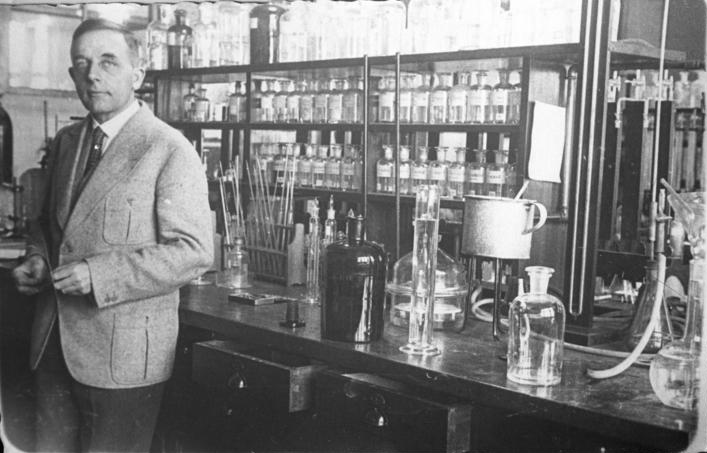
Source & licence
Bundesarchiv, Bild 102-12525 / Georg Pahl / CC-BY-SA 3.0 DE
Source photograph · CC BY-SA 3.0 DE
Commons version cropped in 2013. JPEG reused without additional retouching or cropping by MICA; original licence retained.
Rights checked : 2026-10-08 · Bild 102-12525
Context
In the early twentieth century, understanding cell life involved connecting physiological observations with measurable chemical reactions. Warburg's training combined these domains: a chemistry doctorate in Berlin in 1906, then a medical doctorate in Heidelberg in 1911. This background encourages attention to the instruments, measurements and experimental systems underlying his findings rather than reducing his work to the name of a single phenomenon.
What happened
8 October 1883 is his birth date, recorded in the Nobel biography. This page therefore marks a biographical event. The 1931 award recognised a different stage: research into the nature and action of the respiratory enzyme. The selected archive photograph shows him in a laboratory in October 1931. It documents a period of his career and clearly does not depict his birth.
People and institutions
Nobel sources place his training with Emil Fischer and Ludolf von Krehl. His research subsequently developed in Berlin-Dahlem. The institutional history of early biochemistry also places his techniques in contact with other scientists' work, including Otto Meyerhof. These connections show how an individual career belongs within laboratories, experimental traditions and exchanges between chemistry, medicine and physiology.
Why it matters
The Nobel citation concerns cellular respiration. It should not be replaced by the claim that the prize recognised a universal theory of cancer. A contemporary Nature note, published in November 1931, described his investigations of oxygen use and tumour-tissue metabolism. It already stressed that respiration and fermentation did not establish an absolute distinction between normal and tumour tissues.
Consequences
The historical value of this work is also methodological: processes of life became objects of quantitative comparison. Metabolic research moved beyond describing an organ to asking questions at the cellular scale. The Nobel account of early biochemistry illustrates this collective development. Revisiting it helps distinguish a measurement, its interpretation and a more general hypothesis.
What it means today
Warburg offers an introduction to the history of metabolism, but older sources require contextual reading. A 1931 statement is not a current clinical recommendation. MICA's purpose here is documentary: preserve the exact reason for the prize, credit the image correctly and avoid shortcuts connecting a famous name, a hypothesis and a therapeutic promise. No treatment advice is drawn from these historical experiments.
Key points
- 8 October 1883: birth, not the Nobel announcement.
- The 1931 prize concerns the respiratory enzyme.
- Tumour research does not establish a universal clinical theory.
- The authentic October 1931 photograph is distinct from the birth event.
References
- Otto Warburg — Biographical
NobelPrize.org · Consulted 2026-10-11 · Institutional text indexed; direct access limited
- The Nobel Prize in Physiology or Medicine 1931 — Summary
NobelPrize.org · Consulted 2026-10-11 · Institutional text indexed; direct access limited
- News and Views, Nature 128,789–793(1931)
Nature — archive contemporaine de 1931 · Consulted 2026-10-11
- Otto Meyerhof and the Physiology Institute: the Birth of Modern Biochemistry
NobelPrize.org · Consulted 2026-10-11 · Institutional text indexed; direct access limited
- Bundesarchiv Bild 102-12525 — Otto Heinrich Warburg
Bundesarchiv / Wikimedia Commons · Consulted 2026-10-11
Documentary review in French and English. Historical facts are distinct from current clinical advice.