1993 · Nobel Prize announcement
1993: the medicine Nobel honours split genes
On 11 October 1993, Richard J. Roberts and Phillip A. Sharp were recognised for a 1977 discovery: some genes do not form one uninterrupted coding sequence.
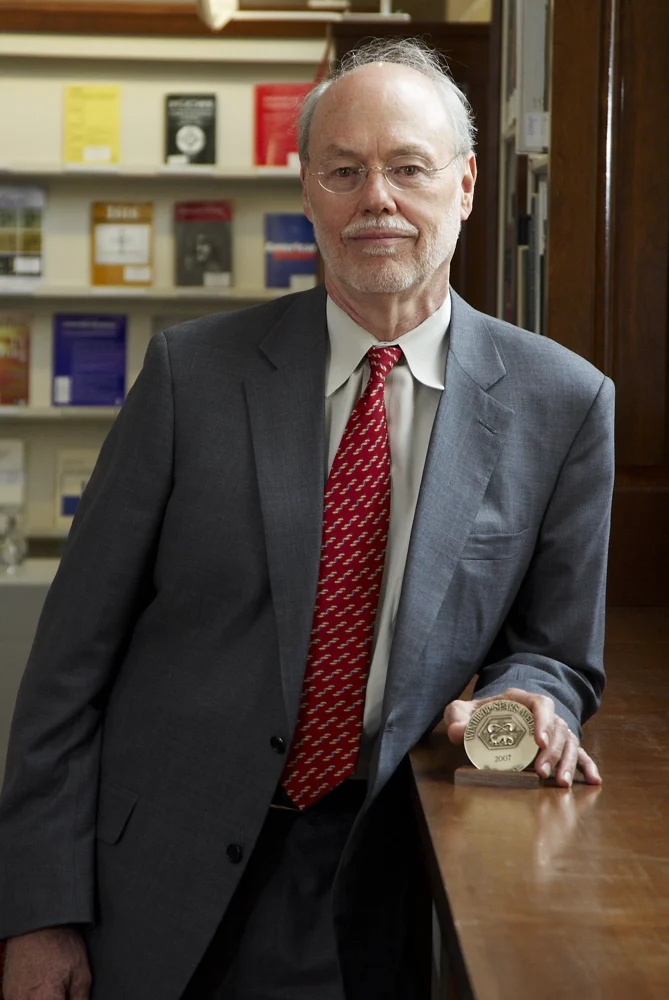
Source & licence
Science History Institute / staff photographer / Wikimedia Commons
Source photograph · CC BY-SA 3.0 Unported
The source version and any previous cropping are described in the credit. MICA: proportional resizing and WebP conversion; no generative retouching.
Rights checked : 2026-10-11 · nobel-medecine-1993-genes-morceles
Context
In the 1970 s, viruses provided experimental systems for investigating the organisation of genetic information. Research teams studied adenovirus in particular. Comparing DNA with its RNA message became a way of asking a precise question: did the final message correspond to a continuous stretch of the genome? This setting matters as much as the award date, because the discovery arose from an experimental question and techniques that made differences visible.
What happened
The Nobel release dated 11 October 1993 announced a shared prize for Roberts and Sharp. It recognised split genes. The announcement was a public act of recognition, not the date of the first observation. The convergent investigations dated back to 1977. MIT's contemporary account states that Sharp received Stockholm's call on Monday 11 October and attended a press conference that day. The article appeared on 20 October; its publication date therefore does not replace the announcement date.
People and institutions
Roberts carried out his research at Cold Spring Harbor Laboratory; Sharp performed the award-winning work at MIT. Their teams worked independently. CSHL's archives place Roberts on a path from restriction enzymes to adenovirus transcription. The involvement of two laboratories reminds us that an award to individuals should not obscure the teams, methods and exchanges that make a discovery possible.
Why it matters
The segments retained in the mature message are exons; intervening portions may be removed during RNA splicing. This organisation changed the concept of a gene. It required a distinction between the DNA sequence, the initial transcript and mature RNA, rather than treating them as three identical copies. It was a fundamental change in the model used to understand gene expression.
Consequences
Sharp's laboratory highlights the connections between splicing, gene expression and disease research. Institutional accounts also discuss evolutionary implications. The educational consequence is to follow several stages: observation, interpretation, independent verification and integration into a broader model. The Nobel recognised that progression; the prize itself is not the experimental evidence.
What it means today
Revisiting this episode helps explain why genomic information cannot be interpreted merely as a list of sequences. It also encourages reading the figures and methods in original research. This is a historical account, offering neither an individual genetic test nor treatment advice. An anniversary brings a discovery into view without claiming to cover all its subsequent applications.
Key points
- 11 October 1993: announcement;1977: discovery.
- Roberts and Sharp worked independently.
- DNA, the initial transcript and mature RNA are distinct.
- Splicing became central to understanding gene expression.
References
- The Nobel Prize in Physiology or Medicine 1993 — Press release
Nobel Assembly / NobelPrize.org · Consulted 2026-10-11 · Institutional text indexed; direct access limited
- Sharp garners share of Nobel prize
Massachusetts Institute of Technology · Consulted 2026-10-11
- CSHL's Nobel Laureates —1993
Cold Spring Harbor Laboratory · Consulted 2026-10-11
- Richard J. Roberts — personal collection
Cold Spring Harbor Laboratory · Consulted 2026-10-11
- Phillip A. Sharp — Sharp Lab
Massachusetts Institute of Technology · Consulted 2026-10-11 · Institutional text indexed; direct access limited
Documentary review in French and English. Historical facts are distinct from current clinical advice.