1999 · Nobel Prize announcement
1999: Günter Blobel and protein addresses
On 11 October 1999, the medicine Nobel was announced for Günter Blobel: proteins carry signals that help determine their transport and location within a cell.
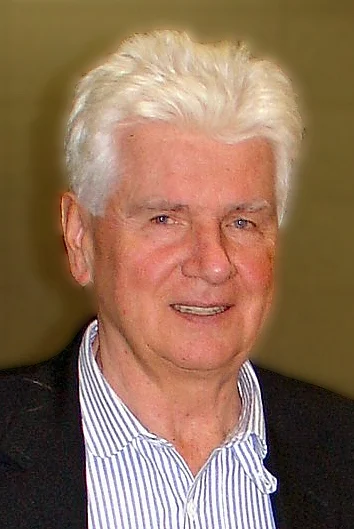
Source & licence
Masur / Wikimedia Commons ; version recadrée et retouchée déposée par Frze en 2017
Source photograph · CC BY-SA 4.0 (choix parmi licences proposées)
The source version and any previous cropping are described in the credit. MICA: proportional resizing and WebP conversion; no generative retouching.
Rights checked : 2026-10-11 · nobel-medecine-1999-adressage-proteines
Context
A cell contains compartments with different functions. Making a protein is therefore insufficient: it also has to reach the place where it performs its role. Experimental cell biology, emerging from research on organelles, raised this question about the journey from production to destination. Blobel addressed it at Rockefeller, building on the work of George Palade and colleagues. A problem of internal organisation became a testable molecular question.
What happened
On 11 October 1999, Rockefeller issued a release announcing the award to its scientist. The Nobel release bears the same date. The prize recognised intrinsic protein signals governing transport and localisation. This landmark requires careful reading:1999 was the year of recognition, whereas the hypothesis and decisive experiments had been developed earlier. An announcement anniversary does not turn a history spanning decades into a discovery completed in a single day.
People and institutions
Günter Blobel worked at Rockefeller and was also a Howard Hughes Medical Institute investigator when he received the prize. His university's account credits David Sabatini with helping formulate the signal hypothesis in 1971. It then describes a 1975 experimental system without intact cells, designed to examine translation and translocation separately. These landmarks distinguish an explanatory hypothesis from testing it experimentally.
Why it matters
The central idea is that information within a protein can contribute to directing it to its destination. A postal code is a teaching analogy; it does not imply that every compartment and every protein use an identical mechanism. Work on the endoplasmic reticulum made stages of recognition and membrane passage experimentally accessible. Localisation thus became part of the biological question alongside production.
Consequences
Rockefeller's archives describe translocation methods as tools that spread across laboratories. They place protein targeting within understanding physiology and pathology. For the history of science, this sequence demonstrates the strength of experimental reconstitution: separating components allows researchers to ask what is necessary for a particular stage, then reconstruct a mechanism rather than simply describe an image.
What it means today
This episode offers a way of reading cell biology: ask where a molecule is, how it gets there and what evidence supports the explanation. The postal metaphor is an introduction, not a demonstration. This account derives no individual medical advice from the discovery. It preserves a distinction between a fundamental finding, subsequent developments and clinical applications that require their own evidence.
Key points
- 11 October 1999: verified Nobel announcement.
- 1971: signal hypothesis;1975: experimental system described by Rockefeller.
- Producing a protein and locating it are different questions.
- A postal-code analogy does not imply one mechanism for every protein.
References
- The Nobel Prize in Physiology or Medicine 1999 — Press release
Nobel Assembly / NobelPrize.org · Consulted 2026-10-11 · Institutional text indexed; direct access limited
- Rockefeller University Cell Biologist, Günter Blobel, Wins 1999 Nobel Prize in Medicine
Rockefeller University · Consulted 2026-10-11
- Günter Blobel —1999 Nobel Prize
Rockefeller University · Consulted 2026-10-11
- Günter Blobel: Stockholm and beyond
Rockefeller University Archives · Consulted 2026-10-11
- Günter Blobel — Facts
NobelPrize.org · Consulted 2026-10-11 · Institutional text indexed; direct access limited
Documentary review in French and English. Historical facts are distinct from current clinical advice.