Death · 2 November 1905
Death of Albert von Kölliker
Albert von Kölliker was a pioneer of modern histology. A physician, anatomist and teacher, he helped establish microscopic observation as a central way of understanding the body. His career connects the study of tissues, medical education and the beginnings of several fields of research.[1][4]
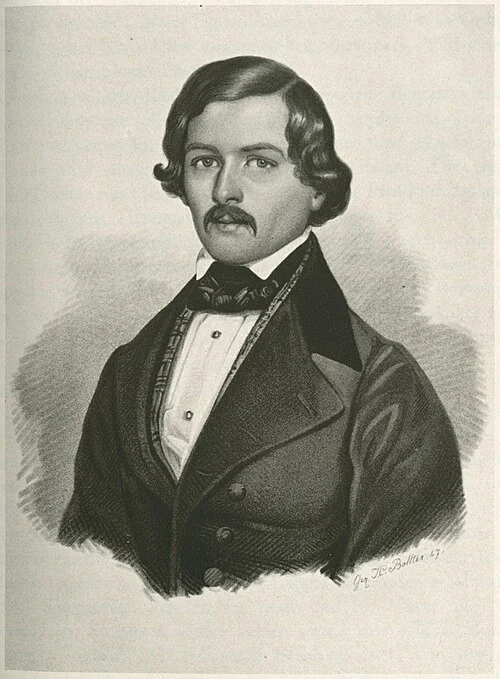
Credit and rights
Auteur non indiqué / Die Universität Zürich und ihre Vorläufer (1938), via Wikimedia Commons · Public domain · redimensionnement proportionnel / proportional resize, WebP
Original source · LicenceKey dates and milestones
- 6 July 1817
Born in Zurich, where he begins an education that will later take him to several European university centres.[2]
- 1836–1842
Studies in Zurich, Bonn and Berlin. Earns a doctorate in philosophy in Zurich in 1841 and a medical doctorate in Heidelberg in 1842.[2]
- 1847
Is appointed professor at Würzburg, the university where he builds a long career in research and teaching.[1]
- 1852
Publishes Handbuch der Gewebelehre des Menschen, a textbook of human histology for physicians and students.[3]
- 1856
Investigates the heart’s electrical activity with Heinrich Müller. These experiments belong to the history preceding clinical electrocardiography.[8]
- 23 January 1896
Takes part in the public presentation of X-rays in Würzburg; Röntgen radiographs his hand.[7]
- 2 November 1905
Dies in Würzburg at the age of 88, after decades devoted to microscopic anatomy.[1]
Contributions to medicine
- Understanding tissues: he helps establish the identity of smooth muscle cells and clarify the organisation of many tissues. His observations also include renal structures and intestinal epithelium, connecting cells with the organs they form.[4][5]
- Exploring the nervous system: his research contributes to the foundations of neuron theory. He later recognises Santiago Ramón y Cajal’s findings and helps disseminate them; this scientific development involves several researchers and experimental traditions.[5][6]
- Training physicians: his practical microscopy courses involve students directly in observation. His textbook organises knowledge of human tissues and supports their learning of anatomy at a new scale.[2][3]
Documented anecdotes
His hand enters the history of radiology
During the January 1896 meeting, Kölliker offers his hand for Röntgen’s demonstration. Impressed by the result, he proposes naming the new rays after their discoverer. This famous radiograph accompanies a public presentation; it is not the first human radiograph.[7]
A surviving textbook and a method to explore
A copy of the 1852 textbook held by the Royal College of Physicians is now digitised in Wellcome Collection. Readers can connect Kölliker’s well-known name with the actual book through which his discipline was taught to physicians and students.[3]
Documentary sources
- Albert von Koelliker — biographie universitaire
Archives de l’université de Würzburg
- Albert Kölliker — notice de Christoph Mörgeli
Dictionnaire historique de la Suisse / Historisches Lexikon der Schweiz
- Handbuch der Gewebelehre des Menschen — édition originale de 1852
Wellcome Collection / Royal College of Physicians
- Heirs of Hippocrates, notice 1848 — Kölliker, 1852
University of Iowa Libraries
- Koelliker, Albert Ritter von — notice d’Erhart Kahle
Neue Deutsche Biographie
- Hildebrand R. Relations de Kölliker avec Golgi et Ramón y Cajal. Sudhoffs Archiv. 1989;73(2):145–155
Sudhoffs Archiv / National Library of Medicine
- Wilhelm Conrad Röntgen — exposition historique
Röntgen-Memorial / Röntgenkuratorium Würzburg
- Frank R. Un siècle d’enregistrement du signal électrique cardiaque, 1987
Bulletin d’histoire de l’électricité / Persée