Milestone · 2 November 1869
Presentation of Dieulafoy’s aspirator
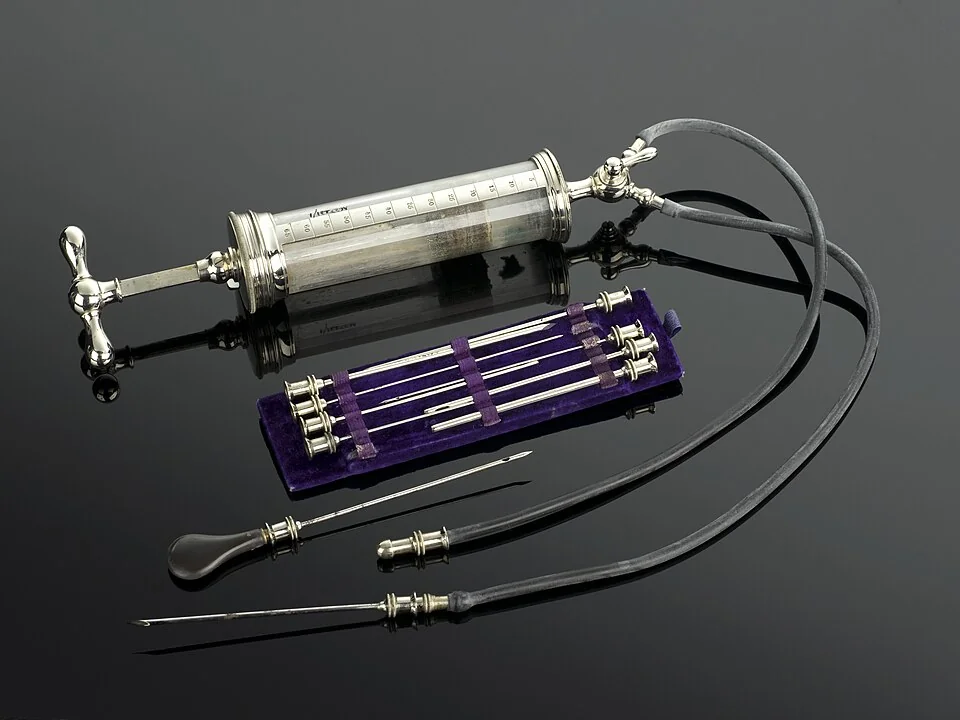
On 2 November 1869, Adolphe Gubler presented an aspirator to the Academy of Medicine, developed to Georges Dieulafoy’s specifications. Manufactured by Robert and Colin, it combined a fine needle with a previously created vacuum to investigate or evacuate fluid collections.[1]
Credit and rights
Science Museum, London / Wellcome Images, via Wikimedia Commons · CC BY 4.0 · redimensionnement proportionnel / proportional resize, WebP
Original source · LicenceKey dates and milestones
- 18 November 1839
Paul Georges Dieulafoy is born in Toulouse; he will become a Paris-based physician specialising in internal medicine and a medical teacher.[4]
- 1863–1869
Moves to Paris and joins Trousseau’s department in 1863. In 1869, he defends a thesis on sudden death in typhoid fever.[3]
- 2 November 1869
Gubler presents the aspirator to the Academy; Dieulafoy’s original note is published in the Gazette hebdomadaire on 5 November.[1]
- 1870–1873
Publishes his aspiration method in 1870 and a treatise in 1873. The apparatus is also shown at the Vienna Universal Exhibition in 1873.[2][5]
- 1880–1896
Begins publication of his Manuel de pathologie interne in 1880. In 1896, he becomes professor of clinical medicine at the Hôtel-Dieu.[3]
- 1910
Presides over the National Academy of Medicine, having belonged to its medical pathology section since 1890.[4]
- 16 August 1911
Dies in Paris after a career devoted to clinical medicine, teaching and exchanges between medicine and surgery.[3][4]
Contributions to medicine
- A simple mechanism: a syringe, needles or cannulas, and stopcocks allow a vacuum to be created and then applied. Fluid movement relies on this suction; the instrument’s value lies in the practical arrangement of its components.[2]
- A link between diagnosis and treatment: Dieulafoy proposes collecting fluid to determine its nature and considering evacuation. His note includes joint and pleural effusions among its applications.[1]
- A clinical approach: his textbook links the description of diseases with diagnosis, prognosis and treatment. His teaching combines bedside observation with pathological knowledge and the investigations available in his time.[3]
Documented anecdotes
An innovation immediately disputed
In his 1873 treatise, Dieulafoy describes priority claims arising in France and abroad after the presentation. He emphasises the combination of fine needles with a vacuum created in advance. The account also reveals the human side of innovation: its advocates must publish observations, defend their choices and persuade their colleagues.[5]
Documentary sources
- Dieulafoy G. Note sur un aspirateur sous-cutané ; séance du 2 novembre 1869
Gazette hebdomadaire de médecine et de chirurgie / BIU Santé
- Aspirateur pneumatique de Dieulafoy — notice d’instrument
Conservatoire du patrimoine hospitalier régional, Rennes
- Manuel de pathologie interne — notice patrimoniale
Conservatoire du patrimoine hospitalier régional, Rennes
- Dieulafoy Paul Georges — notice biographique
Comité des travaux historiques et scientifiques, École nationale des chartes
- Dieulafoy G. A Treatise on the Pneumatic Aspiration of Morbid Fluids, 1873
Ouvrage original numérisé / Internet Archive