Birth · 4 November 1929
Birth of Charles Baxter, surgeon at the Dallas burn centre
In the history of burn care, Parkland denotes both a Dallas hospital and a formula associated with Charles Baxter. His work began with a measurable clinical question about circulatory changes after extensive burns and the response to administered fluids. Research with Tom Shires was published in 1968. The hospital’s name subsequently became familiar far beyond Texas.[1][2]
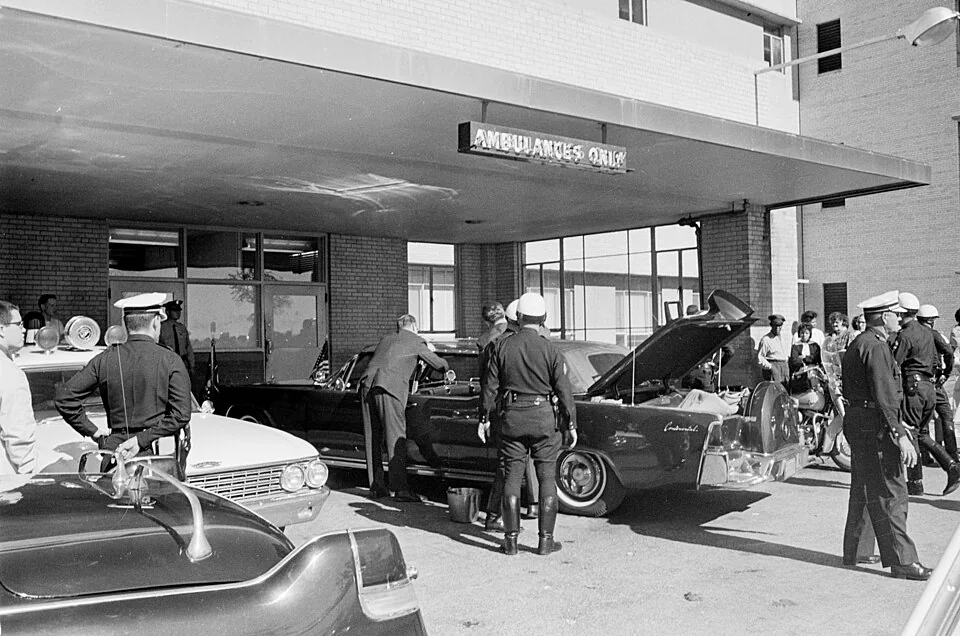
Credit and rights
Cecil Stoughton · White House Photographs, John F. Kennedy Presidential Library and Museum, via Wikimedia Commons · Public domain · redimensionnement proportionnel / proportional resize, WebP
Original source · LicenceKey dates and milestones
- 4 November 1929
Charles Rufus Baxter is born in Paris, Texas.[1]
- 1954
He earns his medical degree in Dallas. Research and surgical training follow.[1]
- 1968
Baxter and Shires publish their study of the physiological response to crystalloid resuscitation in severe burns.[2]
- 1972
He serves as president of the American Burn Association, a community bringing together clinical care, surgery and research.[1]
- 1973
A child with burns over 92% of body surface area left the unit after receiving an allograft from the new skin bank.[1]
Contributions to medicine
- The paper by Baxter and Shires places the formula in the context of research into severe burns. It is a historical source for the origin of the eponym. Contemporary treatment decisions require current guidance.[1][2]
- The Parkland formula provided a numerical framework for initial fluid replacement after burns. Historically, it arose from physiological observations and teamwork rather than from one isolated rule. Its later clinical use still requires monitoring and adjustment to the patient.[1][2]
- Baxter also contributed to the organisation of care through a specialist unit, skin bank, research, training and publication. This infrastructure connected experimentation, hospital treatment and communication of findings in a specialty that was still developing.[1]
- His career combined clinical responsibility with the building of professional institutions. Leadership of a research centre, service in specialist societies and editorial work carried observations from the ward into networks for training, comparison and shared standards.[1]
Documentary sources
- Charles Rufus Baxter · Biographie
Life in the Fast Lane
- Physiological response to crystalloid resuscitation of severe burns
Annals of the New York Academy of Sciences · PubMed