Milestone · 8 November 1895
Röntgen discovers X-rays
8 November marks a physics discovery that became essential to medicine. In Würzburg, Röntgen identified previously unknown rays, soon called X-rays.[1]
Credit and rights
W. C. Röntgen / Wellcome Collection ; restauration numérique Yann (2024). Domaine public. · Public domain · redimensionnement proportionnel / proportional resize, WebP
Original source · LicenceKey dates and milestones
- 1868
He earned a mechanical engineering diploma in Zurich before pursuing research in physics.[2]
- 8 November 1895
His experiments with cathode-ray tubes led to the observation of the new radiation.[2]
- 22 December 1895
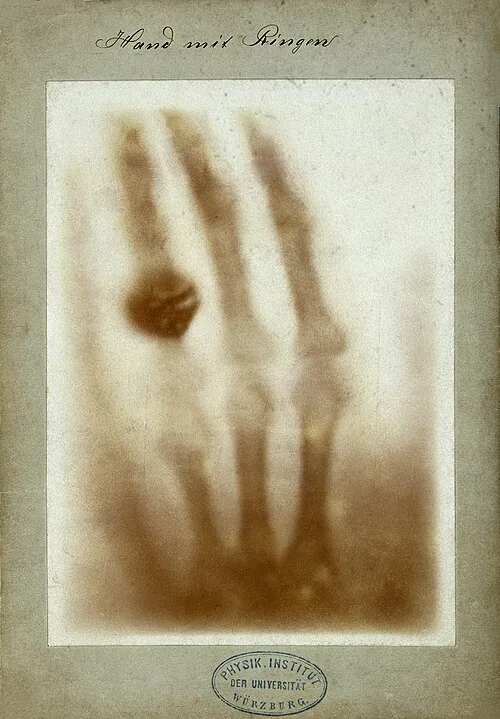
He radiographed his wife’s left hand, revealing its bones and a ring.[3]
- 1901
The first Nobel Prize in Physics recognised this discovery.[2]
Contributions to medicine
- Radiography made it possible to examine internal structures without a surgical incision. Physicians quickly recognised its value for examining the body.[3]
Documented anecdotes
An engineer’s path
In Zurich, meeting physicist August Kundt drew him towards laboratory work. This experimental training preceded his discovery by decades.[1]
Documentary sources
- Wilhelm Conrad Röntgen — Nobel Prize in Physics 1901
Université de Zurich
- Wilhelm Conrad Röntgen (1845–1923)
ETH Library, ETH Zurich
- Radiographie de la main d’Anna Bertha Röntgen, 22 décembre 1895
Science Museum Group