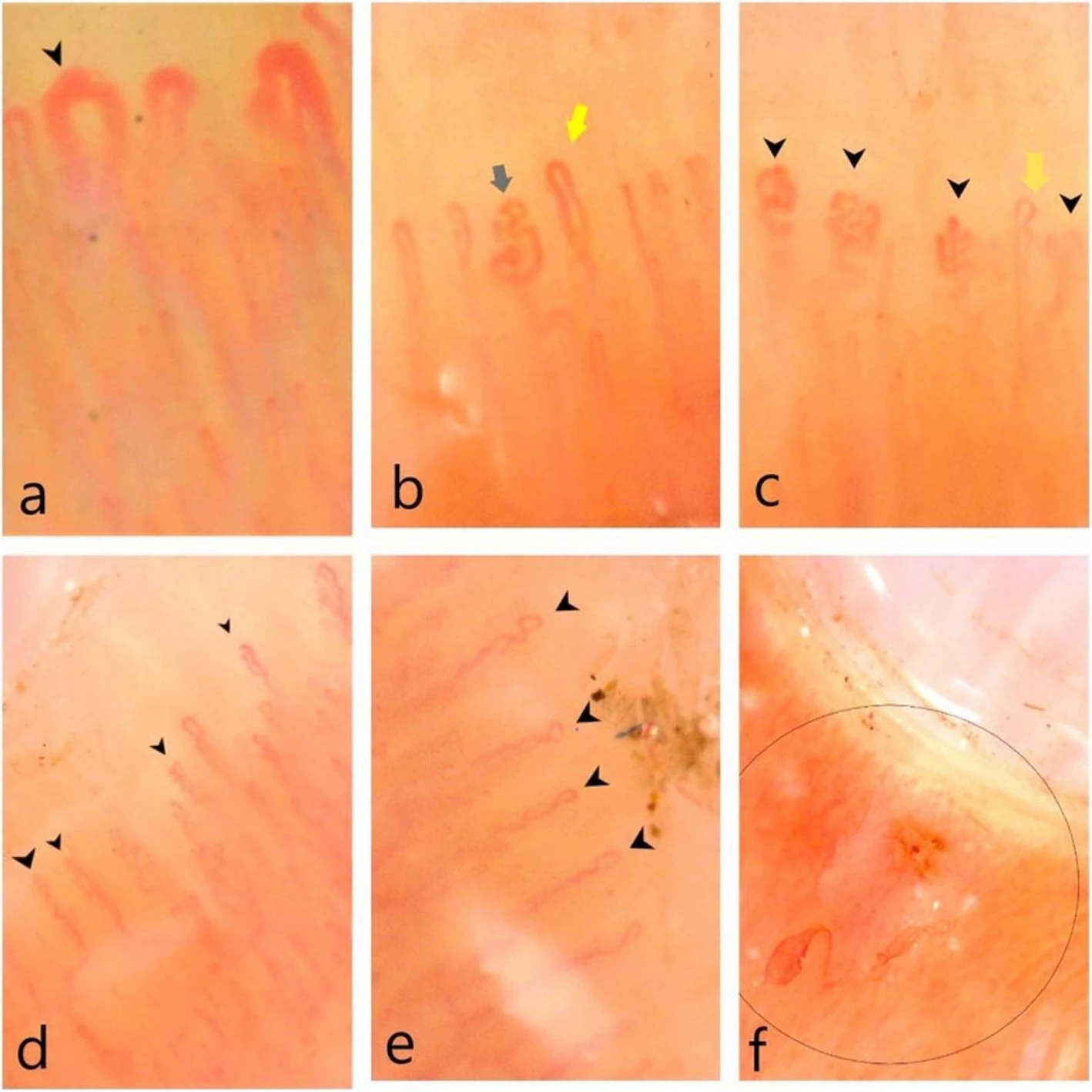
Flash information
- Calibre
- Look for giant capillaries
- Density
- Count per calibrated length
- Haemorrhage
- Assess within the pattern
- Architecture
- Organisation and neoangiogenesis
Definition
Nailfold capillaroscopy describes microcirculation; a scleroderma pattern combines characteristic abnormalities.
Examination or reading method
Examine several fingers after acclimatisation; check scale and recognise trauma, manicure effects or poor visibility.
Morphological description
Describe calibre, density, haemorrhage, avascular areas and architecture; one enlarged capillary is insufficient.
Causes and diagnostic direction
The pattern suggests the scleroderma spectrum; comparable abnormalities may accompany other connective-tissue diseases.
Differential diagnoses
Non-specific abnormalities and traumatic microhaemorrhage must be distinguished from an organised disease pattern.
Associated findings
Integrate Raynaud phenomenon, puffy fingers, sclerodactyly and autoantibodies; capillaroscopy does not replace clinical assessment.
Red flags
Capillary loss indicates microvascular damage; a single image does not grade overall systemic severity.
Pitfalls and limitations
Early, active and late are morphological patterns, not precise measures of disease duration.
Take-home message
Assess all components and multiple fields; assign a pattern only with the necessary information.
Sources
- Nailfold capillaroscopy—Principles and clinical application - PMC ↗
- Nailfold capillaroscopy in systemic sclerosis – state of the art: The evolving knowledge about capillaroscopic abnormalities in systemic sclerosis - PMC ↗
Documentary review: 2026-10-12
Media source & rights
- Author
- Arjun Prakashey; Hita H. Mehta; Sushil Pande; Lokesh S. Jappa; Shreya Deoghare; Amitkumar Rameshbhai Gorasiya
- Original source
- Arjun Prakashey; Hita H. Mehta; Sushil Pande; Lokesh S. Jappa; Shreya Deoghare; Amitkumar Rameshbhai Gorasiya · Capillaroscopie : capillaires géants et anomalies morphologiques · https://link.springer.com/article/10.1186/s43162-025-00436-7/figures/1 · CC BY 4.0
- Licence
- CC BY 4.0
- Changes
- EXIF omitted; proportional resize and WebP conversion; no medical pixels retouched.
- Dimensions
- 1418 × 1418 px
- Check
- 2026-10-11