Flash information
- Trigger
- Cold or stress
- Mechanism
- Digital vasospasm
- Colours
- Pallor, cyanosis, variable redness
- Severity
- Ulcer or persistent ischaemia
Definition
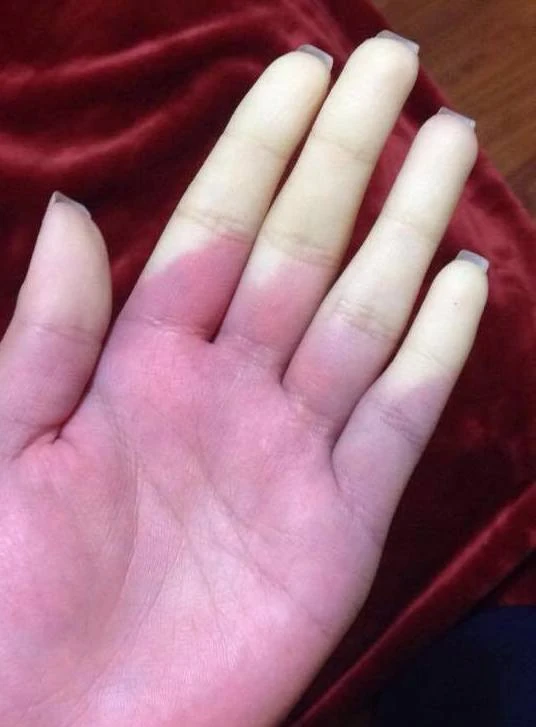
Raynaud phenomenon is a transient reduction in digital blood flow caused by vasospasm.
Examination or reading method
Establish triggers, colour sequence, duration, symmetry, age at onset and connective-tissue disease features.
Morphological description
Digits may become white, then blue and red; all three phases are not required.
Causes and diagnostic direction
Distinguish primary from secondary disease: connective-tissue disease, medicines, vibration exposure or arterial disease.
Differential diagnoses
Persistent cyanosis or fixed ischaemia warrants consideration of another circulatory disorder.
Associated findings
Look for puffy fingers, sclerodactyly and digital lesions; capillaroscopy contributes to determining the cause.
Red flags
Persistent pain, ulceration or gangrene requires prompt assessment of digital perfusion.
Pitfalls and limitations
An image of pallor alone establishes neither episodic behaviour nor a particular systemic disease.
Take-home message
Identify vasospasm and seek features suggesting a secondary form.
Sources
Documentary review: 2026-10-12
Media source & rights
- Author
- MSM98
- Original source
- MSM98 · Phénomène de Raynaud · https://commons.wikimedia.org/wiki/File:Raynauld.jpg · CC BY-SA 4.0
- Licence
- CC BY-SA 4.0
- Changes
- Only proportional resize and WebP conversion; no medical alterations; metadata removed.
- Dimensions
- 536 × 727 px
- Check
- 2026-10-11